
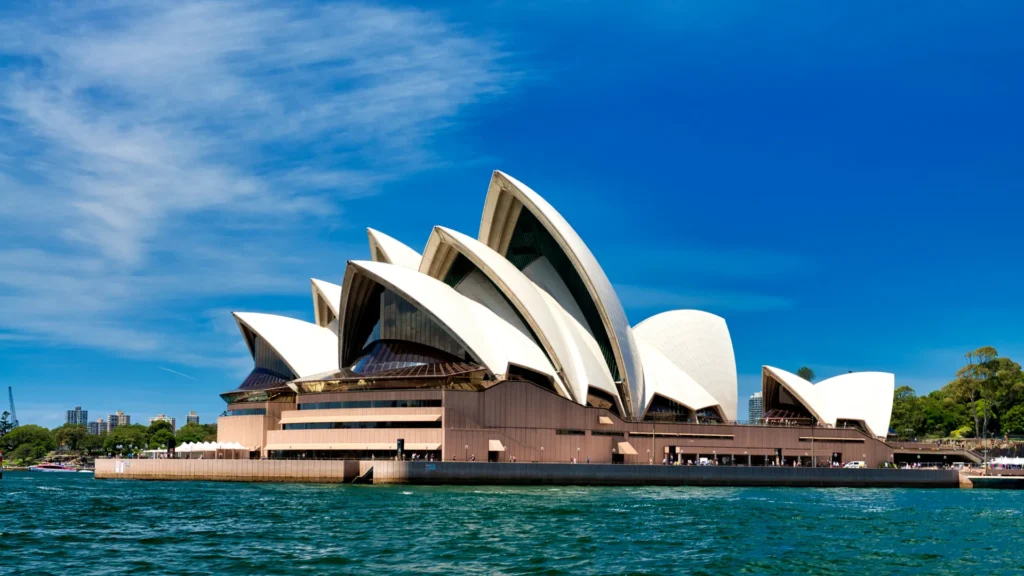
Introduction to the Sydney Opera House
The Sydney Opera House is a World Heritage Site and one of the most visited places in the world. It is located at Bennelong Point in Sydney, New South Wales, Australia. The opera house resembles a white sailboat or oyster, and the roofs are shaped like folded paper or sails. The architect Jørn Utzon designed the opera house. The opera house is essentially a major performing arts center in Australia. It hosts numerous events every year.
A Guided Walk Through an Architectural Icon
The Opera House is a unique architectural masterpiece. Danish architect Jørn Utzon designed this magnificent structure in 1957. The project was completed in 1966 by a team led by Australian architect Peter Hall.
Basic description of the Opera House:
Structure: This is a masterpiece of modern architectural design. The sail-shaped shells or roofs are a prime example. The shells are built on a 75.2-meter-radius sphere covered with white and cream ceramic tiles, which form the roof of the structure, which is placed on a large platform. The highest point of the roof is 67 meters above sea level, which is the same height as a 22-story building. The opera house is built on 1.8 hectares of land, measuring 183 meters long and 120 meters wide. The building is supported by 588 concrete pillars placed 25 meters below the sea level.
The Story Behind the Famous White Sails
Just as the Opera House designed by Jorn Utzon is a beautiful landmark that attracts people from all over the world, there is also some unknown history behind this architecture that is unknown to many people.
Design and Construction:
Danish architect Jorn Utzon designed the Opera House in 1957. The New Wales government selected Utzon’s design from 233 designs. This building was built in 3 stages over a long period of 14 years. In the first stage – the podium, in the second stage – the shell, in the third stage – the interior was built.
Reasons for controversy and delay:
The increasing cost of construction, which created political pressure. Jorn Utzon resigned due to these delays, later an Australian team led by Peter Hall completed the construction of this beautiful building after a long period of 14 years of effort and a cost of 102 million dollars.
Opening:
Queen Elizabeth II officially opened the building on October 20, 1973.
Legacy:
UNESCO listed the Opera House as a World Heritage Site in 2007.
Sydney Opera House Inside
The Opera House is spread over 1.8 hectares. This vast space includes a large concert hall, the Joan Sutherland Theatre, the Drama Theatre, the Playhouse, the Studio, the Utzon Room and the Yallamundi Room. Various events in the city of Sydney are organized at this Opera House. There are many performance venues, which together host more than 1,800 performances a year. More than one million people can enjoy it together. The Opera House is also a tourist attraction, with about 350,000 visitors taking guided tours of the building each year.
Concert Halls
The Opera House has a large concert hall with a seating capacity of 2,679, which is used primarily by the Sydney Symphony Orchestra and other concert performers. The Sydney Opera House Grand Organ is the world’s largest mechanical tracker action organ, with over 10,000 pipes.
Theatres
Like the concert hall, the opera house has five theatres, both large and small. The largest is the Joan Sutherland Theatre, which seats about 1,507. Until 2012, it was better known as the Opera Theatre. There is also a 544-seat Drama Theatre, used by the Sydney Theatre Company and other dance and theatre artists, a 398-seat non-proscenium end-stage theatre. There is also a small studio with 280 permanent seats and a 398-seat non-proscenium end-stage theatre.
Tour Packages, Tickets and Timing
The Opera House is open almost every day. Tours are available for an hour, with entry fees starting at a minimum of $50 for adults and $30 for children. Key options include guided walking tours, VIP tours with dinner at Bennelong, and backstage tours, which explore the concert hall and theatres.